The Screening Activity: SECA (Long Form) dashboard displays de-identified, aggregated, real-time data from all versions of the Social Emotional Competency Assessment (SECA) Long Form.
The forms included are dependent on which versions are assigned to your organization and have at least one completed screen.
The dashboard only displays information about screens that have been finalized and does not include forms that have not been started or are still in progress.
The screening date is based on when the task was completed, not the date the task was originally assigned.
For general information on navigating dashboards, please click this link.
Dropdown/Selectable Filters:
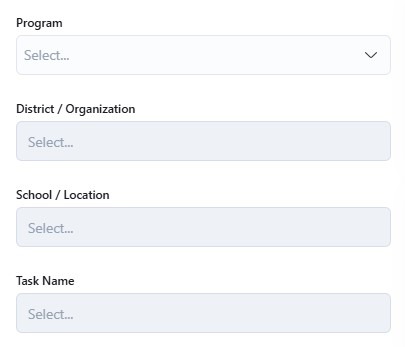
You can use the dropdown/selectable filter options to narrow the dashboard results to only show specific programs, districts/organizations, schools/locations, and/or task name (if there are different versions of the form used). Otherwise, the default view will show all of the forms completed across all participating programs and locations.
Program
District / Organization
School / Location
Task Name (For different versions of the form)
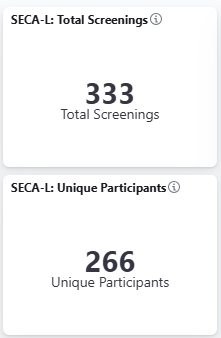
The Screening Activity: SECA (Long Form) dashboard is an easy way to pull the following numbers:
Total number of screenings
Total number of unique participants with at least one completed screen
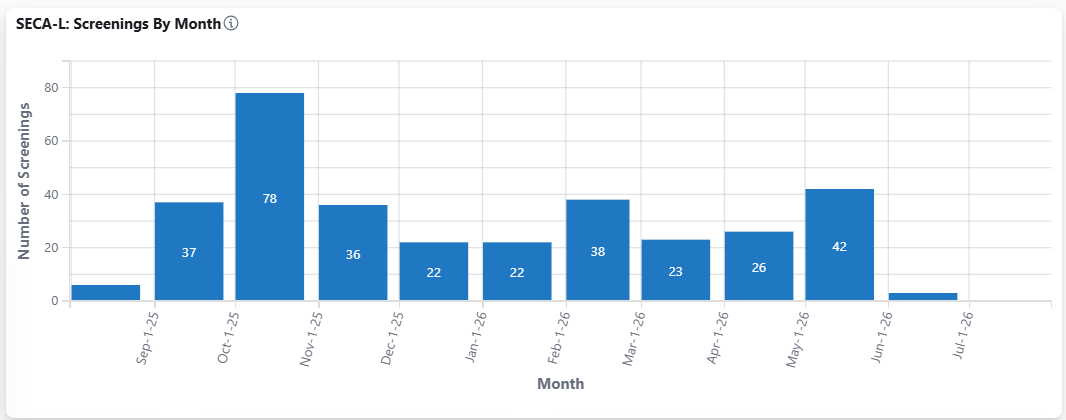
The Screening Activity: SECA (Long Form) dashboard also includes the following charts and tables:
Screenings by Month
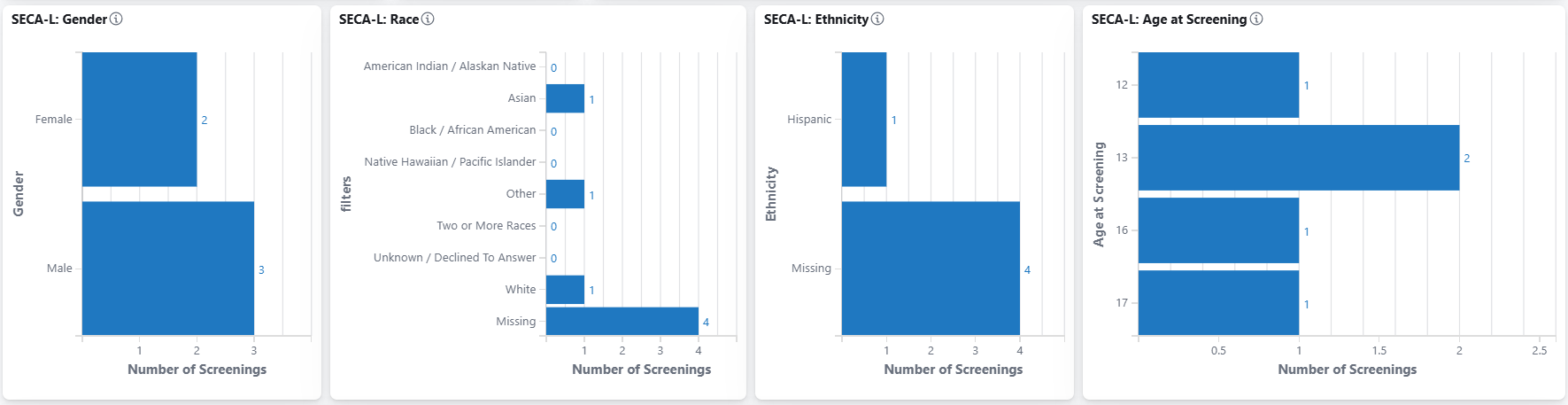
Demographics of the participants who have at least one SECA completed
Gender
Race
Ethnicity
Age at Screening
Average Scores for Each Domain over selected Time Frame
- Self-Awareness: Strengths & Weaknesses
- Self-Awareness: Emotional Knowledge
- Social Awareness
- Self-Management: Emotion Regulation
- Self-Management: Goal Management
- Self-Management: School Work
- Relationship Skills
- Responsible Decision-Making
Percentage of responses for the following questions:
Self-Awareness: Strengths & Weaknesses
Knowing what my strengths are.
Knowing how to get better at things that are hard for me.
Knowing when I am wrong about something.
Knowing when I can’t control something.
Self-Awareness: Emotion Knowledge
Knowing when my feelings are making it hard for me to focus.
Knowing when my mood affects how I treat others.
Knowing ways I calm myself down.
Noticing what my body does when I’m nervous.
Knowing the emotions I feel.
Knowing ways to make myself feel better when I’m sad.
Social Awareness
Learning from people with different opinions than me.
Knowing what people may be feeling by the look on their face.
Knowing when someone needs help.
Knowing how to get help when I’m having trouble with a classmate.
Knowing how my actions impact my classmates.
Staying calm when I feel stressed.
Self-Management: Emotion Regulation
Getting through something even when I feel frustrated.
Being patient even when I am really excited.
Working on things even when I don’t like them.
Self-Management: Goal Management
Finishing tasks even if they are hard for me.
Setting goals for myself.
Reaching goals that I set for myself.
Thinking through the steps it will take to reach my goal.
Self-Management: School Work
Doing my schoolwork even when I do not feel like it.
Being prepared for tests.
Working on assignments even when they are hard.
Planning ahead so I can turn a project in on time.
Finishing my homework without reminders.
Staying focused in class even when there are distractions.
Relationship Skills
Respecting a classmate’s opinions during a disagreement.
Getting along with my classmates.
Sharing what I am feeling with others.
Talking to an adult when I have problems at school.
Being welcoming to someone I don’t usually eat lunch with.
Getting along with my teachers.
Responsible Decision-Making
Thinking about what might happen before making a decision.
Knowing what is right or wrong.
Thinking of different ways to solve a problem.
Saying “no” to a friend who wants to break the rules.
Helping to make my school a better place.
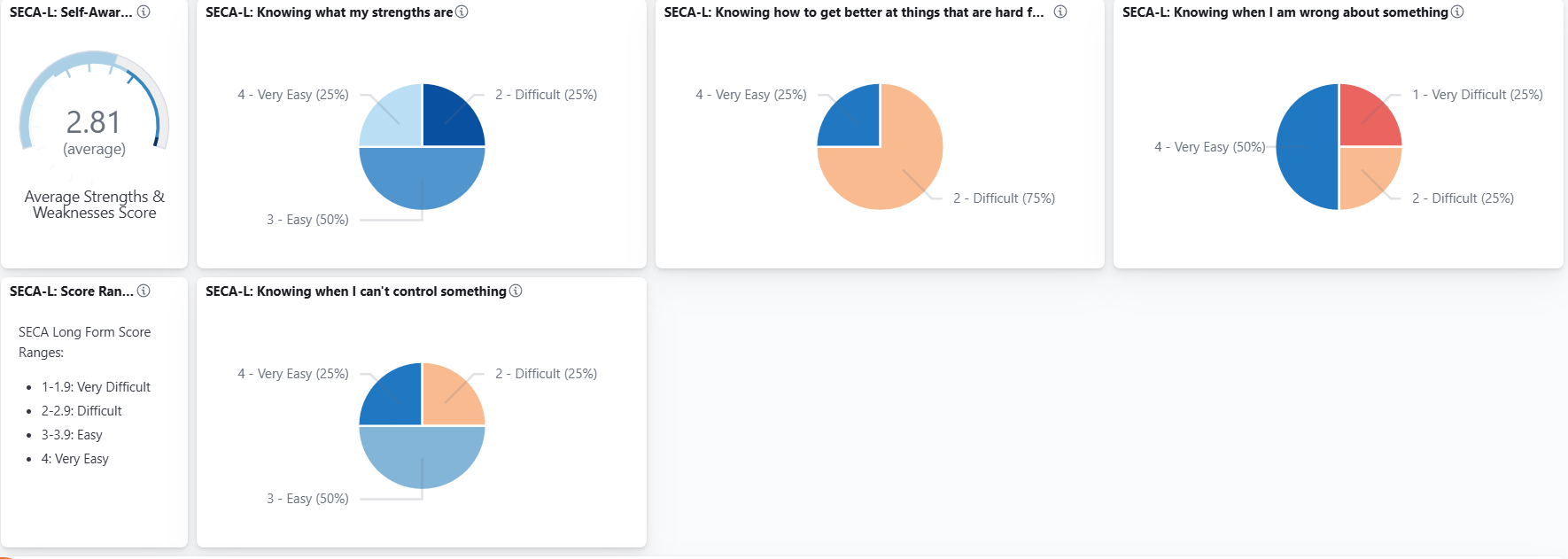
Charts that include ‘skipped’ as a response are displayed for questions that were disabled due to the form’s skip logic, based on the participant’s responses.
If you do not see data in the Average Scores by Task Name / Time Period visual, please contact Customer Support https://mdlogix.freshdesk.com/support/tickets/new to configure this for your organization.
Resetting the Dashboard
To clear individual filters, please click the X next to the filter at the top of the dashboard
To reset the dashboard to its original settings, click the Refresh button on your browser

Download to PDF
Once you have defined the dashboard based on your needs, you can export the entire dashboard as a PDF using the Download to PDF button found on the upper right-hand side.

Was this article helpful?
That’s Great!
Thank you for your feedback
Sorry! We couldn't be helpful
Thank you for your feedback
Feedback sent
We appreciate your effort and will try to fix the article